A Parent’s Guide to Finding SEN-Friendly Art Clubs After School in the UK
A Parent’s Guide to Finding SEN-Friendly Art Clubs After School in the UK
Supporting a child with special educational needs or disabilities (SEND) to enjoy after-school activities can feel daunting. Many parents worry about safety, staff understanding, sensory overload, or their child being excluded if they become overwhelmed.
This guide is written specifically for UK parents who want to find SEN-friendly after-school art clubs that are safe, inclusive and genuinely beneficial for their child’s development. It draws on UK safeguarding expectations, Ofsted frameworks, and current good practice in SEND and arts education.
We will cover:
- How to tell if an art club is genuinely SEN-friendly (not just saying it on a poster)
- What to ask about staff training, qualifications and safeguarding
- How art clubs can support confidence, communication and emotional regulation
- UK costs, funding options and hidden fees to watch for
- Red flags that suggest a club may not be safe or suitable
- Practical checklists you can use when visiting or phoning a club
Whether your child has an EHCP, is on SEN Support, or you simply suspect they may need extra help, this guide is designed to give you concrete, realistic tools to make a confident choice.
1. Why SEN-Friendly Art Clubs Matter
Art is often one of the most accessible and flexible activities for children with SEND. It can be:
- Non-verbal – helpful for children who find spoken language difficult
- Flexible and low-pressure – there is no single “right” answer
- Sensory-rich – textures, colours and materials can be calming or stimulating
- Highly individual – children can work at their own pace and level
For many children, an after-school art club can:
- Build confidence through visible achievements
- Support fine motor skills and hand–eye coordination
- Provide a safe space to process emotions through creativity
- Offer social opportunities in a structured, less competitive environment than sport
However, not every art club is automatically SEN-friendly. Some are noisy, rushed, or run by staff with little understanding of autism, ADHD, learning difficulties, sensory needs or physical disabilities.
A genuinely SEN-friendly art club will:
- Plan for inclusion from the start, not as an afterthought
- Adapt activities, environment and communication
- Work in partnership with parents and schools
- Take safeguarding and behaviour support seriously
The rest of this guide will help you identify those clubs.
2. Understanding What “SEN-Friendly” Should Really Mean
The term “SEN-friendly” is not a regulated label. Any provider can use it in their marketing. As a parent, you need to look beyond the words and check what it means in practice.
2.1 Key features of a genuinely SEN-friendly art club
Look for clubs that can clearly explain how they:
- Differentiate activities – offering simpler and more complex options within the same session
- Use visual supports – picture schedules, step-by-step instructions, visual timers
- Allow flexible participation – children can take breaks, watch first, or work one-to-one when needed
- Manage sensory needs – quieter spaces, reduced clutter, options to avoid messy textures, or use ear defenders
- Support communication – simple language, Makaton or symbol support where needed, patience with processing time
- Plan for behaviour – proactive strategies, calm responses, and clear boundaries rather than punishment
If a provider cannot give specific examples, they may not be as SEN-aware as they claim.
2.2 Legal and policy context in the UK
While after-school clubs are not schools, they are still expected to follow key UK frameworks:
- Equality Act 2010 – they must make reasonable adjustments so disabled children are not disadvantaged.
- Children and Families Act 2014 – underpins the SEND Code of Practice; clubs working on school sites often align with school policies.
- Ofsted requirements (for registered childcare) – including safeguarding, staff suitability, and inclusive practice.
A good provider will be aware of these duties and able to explain how they apply in their setting.
3. Types of After-School Art Clubs in the UK
Understanding the different types of providers helps you know what standards and oversight to expect.
3.1 School-run art clubs
These are organised by the school itself, often led by:
- A teacher or teaching assistant
- An external artist or organisation hired by the school
Pros:
- Staff may already know your child and their needs
- Club is on familiar premises with existing risk assessments
- Usually aligned with school safeguarding and behaviour policies
- Often lower cost or subsidised
Cons:
- Limited spaces and waiting lists
- May be less specialist in art or SEND than dedicated providers
3.2 Private or community-based art clubs
These might run in:
- Community centres or church halls
- Private art studios
- Local arts organisations or galleries
Pros:
- Often more specialist art equipment and projects
- May offer small groups or one-to-one support
- Sometimes run by practising artists or art therapists
Cons:
- Variable understanding of SEND and safeguarding
- May not be Ofsted-registered if only offering short sessions
- Costs can be higher, with extra charges for materials
3.3 Holiday clubs vs term-time after-school clubs
Some providers run both after-school and holiday art clubs. Holiday clubs are more likely to be Ofsted-registered if they provide childcare for longer hours. After-school art clubs of 1–2 hours may or may not be registered, depending on age range and whether they count as childcare.
When in doubt, ask:
“Are you Ofsted-registered for any of your provision? If not, what standards do you follow for safeguarding and staff vetting?”
4. Safeguarding and Ofsted: What Parents Should Check
Safeguarding is non-negotiable. Even the most creative art club is not suitable if basic safety is weak.
4.1 When Ofsted registration is required
In England, an after-school art club may need to be Ofsted-registered if it:
- Looks after children under 8
- Runs for more than 2 hours a day
- Is not run directly by a school on its own site
However, there are exemptions (for example, some activity-based clubs). In Scotland, Wales and Northern Ireland, different regulators apply (Care Inspectorate, CIW, RQIA).
If a club is not Ofsted-registered, that does not automatically mean it is unsafe, but you should ask more detailed questions about their safeguarding procedures.
4.2 Safeguarding questions to ask
Use these as a checklist when you call or visit:
-
DBS checks
- “Do all staff and regular volunteers have an enhanced DBS check?”
- “How often are DBS checks renewed or updated?”
-
Designated Safeguarding Lead (DSL)
- “Who is your Designated Safeguarding Lead, and what training have they had?”
- “What is your process if you have a concern about a child’s safety or wellbeing?”
-
Policies and procedures
- “Do you have written safeguarding and child protection policies I can see?”
- “How do you manage collection at the end of the session and ensure children go home with the right adult?”
-
First aid and medical needs
- “Is there always a paediatric first aider on site?”
- “How do you manage medication, allergies or medical conditions?”
A confident, well-run club will answer these questions clearly and without defensiveness.
4.3 Ofsted reports and what they tell you
If the club is Ofsted-registered:
- Look up their report on the Ofsted website
- Read the sections on safeguarding, leadership and management, and personal development, behaviour and welfare
- Check for any references to inclusion, SEND or working with vulnerable children
Remember: an Ofsted rating is one piece of the puzzle, not the whole picture. Combine it with your own observations and your child’s experience.
5. Staff Qualifications, Training and Ratios
For children with SEND, the quality of staff is often more important than the quality of the art materials.
5.1 What qualifications are realistic to expect?
Not every art club leader will be a qualified teacher, but you can reasonably expect:
- Relevant experience with children (e.g. youth work, teaching assistant, nursery work)
- Some training in safeguarding and basic behaviour management
- Evidence of SEND awareness, such as:
- Experience working in a special school or resource base
- Training in autism, ADHD, social communication, or specific learning difficulties
- Experience adapting activities for children with physical or sensory needs
Useful (but not essential) qualifications might include:
- QTS (Qualified Teacher Status)
- Level 2 or 3 childcare or playwork qualifications
- Youth work qualifications
- Art therapy or therapeutic arts training (note: “art therapist” is a protected title in the UK)
5.2 Ratios and supervision
Ask about:
- Adult-to-child ratios – for mixed-ability groups, many good clubs aim for around 1:6 or 1:8, and may reduce this when supporting children with higher needs.
- One-to-one support – if your child needs close supervision, clarify whether:
- The club can provide this (and at what cost), or
- You or a PA/carer can attend with your child
5.3 Training specifically related to SEND
Ask directly:
- “What training have staff had in supporting children with SEND?”
- “Can you give examples of how you have adapted activities for children with different needs?”
Look for specific answers, such as:
- Using visual schedules for autistic children
- Offering alternative tools for children with fine motor difficulties
- Providing quiet breakout spaces for children who become overwhelmed
Vague answers like “We’re very inclusive” without examples are a warning sign.
6. How Art Clubs Support Confidence, Social Skills and Emotional Wellbeing
A good SEN-friendly art club is about far more than making something to take home. It can play a powerful role in your child’s long-term development.
6.1 Confidence and self-esteem
Art clubs can:
- Provide visible achievements – a finished painting, sculpture or collage
- Allow children to take pride in their ideas and creativity
- Offer safe risk-taking – trying new materials or techniques without fear of failure
For children who struggle academically or socially in school, art can be an area where they shine. This can rebalance how they see themselves.
6.2 Social skills and communication
Well-run clubs build social skills gently, for example by:
- Encouraging shared projects (e.g. group murals)
- Using structured turn-taking (e.g. sharing materials, commenting on each other’s work)
- Supporting peer praise in a guided way (“Tell us one thing you like about someone else’s picture”)
For autistic children or those with social communication difficulties, the focus on a shared activity can make interaction less intense and more manageable.
6.3 Emotional regulation and sensory benefits
Art can help children:
- Express feelings they cannot yet put into words
- Calm down through repetitive, rhythmic actions (e.g. shading, pattern-making)
- Explore sensory experiences in a controlled way (e.g. choosing whether to touch clay or use tools instead)
Ask clubs how they use art to support emotional wellbeing, not just produce “perfect” outcomes.
7. Understanding Your Child’s Needs Before You Choose
Before you start phoning clubs, it helps to be clear about your child’s specific needs and what helps them succeed.
7.1 Key questions to reflect on
Consider:
-
Sensory profile
- Do they seek or avoid certain textures (paint, glue, clay)?
- Are they sensitive to noise, bright lights or strong smells?
-
Communication
- Do they understand verbal instructions easily?
- Do they need visual prompts or demonstrations?
-
Attention and energy
- Can they focus for 10, 20, 40 minutes?
- Do they need movement breaks?
-
Social interaction
- Do they prefer working alone, in pairs, or in small groups?
- Do they find group praise or attention overwhelming?
-
Independence and personal care
- Do they need help with toileting, changing clothes, or washing hands?
7.2 Using school information
If your child has:
- An EHCP
- An Individual Education Plan (IEP) or SEN Support plan
- A Behaviour Support Plan
Ask the school SENCO or class teacher:
- What helps your child stay calm and engaged
- What triggers anxiety or meltdowns
- What level of adult support they usually need
You can then share a short, practical summary with the art club.
8. What to Ask When You Contact a Club
Your first phone call or email is a chance to check both attitude and practicalities.
8.1 Initial contact checklist
When you first get in touch, you might say:
“My child has SEND and is very interested in art. I’m looking for a club that can support them. Could I ask a few questions about how you include children with additional needs?”
Then cover:
-
Experience with SEND
- “Do you currently have any children with SEND attending?”
- “Can you tell me about your experience supporting children with [autism/ADHD/learning difficulties/physical disabilities]?”
-
Adaptations and flexibility
- “How do you adapt activities for different ability levels?”
- “What happens if a child becomes overwhelmed or needs a break?”
-
Environment and group size
- “How many children are usually in a session?”
- “Is there a quieter space available if needed?”
-
Practical support
- “Can you support my child with [toileting/medication/feeding] if needed?”
- “Are parents or carers able to stay initially if that would help?”
-
Trial sessions
- “Do you offer a trial session or a shorter visit so my child can see the space first?”
8.2 How to interpret their responses
Positive signs:
- They welcome your questions and thank you for sharing information
- They give specific examples of how they have adapted for other children
- They suggest a gradual start (e.g. shorter first session, parent staying)
Concerning signs:
- They seem defensive or dismissive (“We treat all children the same”)
- They cannot describe any adaptations they make
- They focus mainly on rules and exclusions rather than support
9. Visiting a Club: What to Look For (and Ask)
Whenever possible, arrange to visit the club without your child first, so you can focus on observing.

9.1 Environment and layout
Look around and ask yourself:
- Is the space cluttered or calm?
- Are there clear pathways for children with mobility needs?
- Is there a quiet corner or side room where a child could take a break?
- Are materials stored safely, with sharp tools supervised?
Ask:
- “Where would a child go if they needed a quiet space for a few minutes?”
- “How do you manage transitions between activities?”
9.2 Visual supports and structure
Check for:
- A visual timetable or written schedule for the session
- Clear rules or expectations displayed in simple language or symbols
- Step-by-step examples of projects
Ask:
- “How do children know what is happening next?”
- “Do you use visual prompts for children who find verbal instructions hard?”
9.3 Staff interactions
If you can observe a session (even briefly), notice:
- Do staff speak calmly and respectfully to children?
- Do they get down to the child’s level (physically and emotionally) when explaining?
- Do they praise effort as well as results?
- How do they respond to a child who is restless, anxious or refusing?
You are looking for warmth, patience and consistency, not perfection.
9.4 Specific questions to ask on a visit
Use this mini checklist:
- “Can you walk me through a typical session from arrival to collection?”
- “How do you handle it if a child refuses to join in or wants to do something different?”
- “What happens if a child has a meltdown or becomes very distressed?”
- “How do you communicate with parents about how the session went?”
- “Do you work with schools or parents to share strategies that help individual children?”
Write down answers while they are fresh in your mind.
10. SEND Inclusion and Accessibility in Practice
Inclusion is more than just allowing a child to attend. It is about actively enabling them to participate and succeed.
10.1 Reasonable adjustments you can expect
Under the Equality Act 2010, clubs should make reasonable adjustments. In an art club, this might include:
- Providing adapted tools (e.g. chunky brushes, scissors with spring action, pencil grips)
- Offering alternative materials (e.g. dry media instead of wet paint for children who dislike mess)
- Allowing extra time to finish tasks
- Letting a child observe first before joining in
- Providing written or pictorial instructions alongside verbal ones
10.2 Supporting different types of needs
Some examples of good practice:
-
Autism / social communication differences
- Clear routines and predictable structure
- Advance warning of changes (e.g. different room, special project)
- Option to work slightly apart from the main group if needed
-
ADHD / attention differences
- Short, varied tasks with movement breaks
- Jobs with responsibility (e.g. handing out materials) to channel energy
- Seating away from major distractions
-
Learning difficulties
- Breaking tasks into small steps
- Using demonstration rather than long explanations
- Allowing a helper to scribe labels or write names
-
Physical disabilities
- Accessible tables and storage
- Adjustable easels or table-top boards
- Willingness to rearrange furniture to create space
-
Sensory needs
- Choice about which materials to use
- Access to ear defenders or quieter spaces
- Avoiding strong-smelling products where possible
10.3 Working with EHCPs and school strategies
If your child has an EHCP or specific strategies that work well in school, ask:
- “Would it be helpful if I shared a short summary of what works for my child?”
- “Are you happy for me to put you in touch with the school SENCO if needed?”
A good club will welcome this joined-up approach.
11. UK Costs, Funding and Hidden Fees
Art clubs vary widely in cost across the UK, depending on location, staffing and materials.
11.1 Typical cost ranges (approximate)
As of recent UK trends, you might expect:
- School-based art clubs: £3–£8 per session (often 45–90 minutes)
- Private/community art clubs: £8–£20 per session (60–90 minutes)
- Specialist or therapeutic art sessions: £25–£60+ per hour (often one-to-one or very small groups)
London and the South East tend to be at the higher end; some northern and rural areas may be lower.
11.2 Hidden or extra costs to check
Ask clearly about:
-
Materials fees
- Are materials included in the session price?
- Are there extra charges for special projects (e.g. canvases, clay firing)?
-
Registration or membership fees
- Is there a one-off joining fee?
- Are there discounts for siblings or low-income families?
-
Late collection charges
- What happens if you are delayed?
-
One-to-one support
- If your child needs additional support, is there an extra cost?
Get all costs in writing (email is fine) before committing.
11.3 Funding and support options
Depending on your circumstances and local area, you might explore:
- Short breaks funding from your local authority for disabled children
- Direct Payments or Personal Budgets via social care or EHCPs
- Local charities or parent–carer forums that offer grants or subsidised activities
- Holiday Activity and Food (HAF) programmes in England, which sometimes include arts provision for eligible families
Contact your local council’s Local Offer website for details of SEND-specific funding and clubs.
12. Borough and Regional Differences Across the UK
Provision varies significantly between local authorities and regions.
12.1 Urban vs rural areas
-
Urban boroughs (e.g. London, Birmingham, Manchester):
- More choice of specialist art providers
- Greater variation in quality and cost
- Higher demand and waiting lists
-
Rural areas:
- Fewer providers, but sometimes closer links between schools and community groups
- Travel and transport can be a bigger barrier
12.2 Local authority SEND priorities
Some councils invest heavily in inclusive arts and short breaks; others focus more on sport or generic childcare.
Check your local SEND Local Offer website for:
- Lists of inclusive or specialist clubs
- Short breaks providers with arts activities
- Parent feedback or forums discussing local options
12.3 Parent concerns that vary by area
Common themes include:
- Inner-city boroughs: concerns about building security, safe collection, and staff turnover
- Suburban areas: worries about over-subscribed clubs and pressure to be “perfect” or competitive
- Rural areas: transport, limited choice, and reliance on volunteers
Wherever you live, the principles in this guide still apply; you may just need to be more flexible about travel or timing.
13. Red Flags: When a Club May Not Be Right for Your Child
Even if a club looks appealing on paper, certain warning signs should make you cautious.
13.1 Safeguarding and safety red flags
- No clear sign of safeguarding policies or reluctance to share them
- Staff unsure about whether they have DBS checks
- Unlocked exits or children able to leave unsupervised
- No clear system for signing children in and out
- Hazardous materials (e.g. solvents, sharp tools) left accessible without supervision
13.2 SEND and inclusion red flags
- Comments like:
- “We treat all children exactly the same” (often code for no adjustments)
- “We’ll see how they get on, but if they struggle we may have to ask them to leave” without discussing support
- No willingness to:
- Adapt activities
- Offer a trial session
- Communicate with school or parents about strategies
13.3 Quality and consistency red flags
- High staff turnover with no clear explanation
- Sessions that appear chaotic with little structure
- Children left waiting with nothing to do for long periods
- Staff shouting, using sarcasm, or shaming children for mistakes
13.4 Gut feeling
Your instincts matter. If you leave a visit feeling uneasy, rushed, or not listened to, it is worth exploring other options, even if you cannot pinpoint exactly why.
14. Helping Your Child Prepare for an SEN-Friendly Art Club
A good match between child and club is important, but preparation can also make a big difference.
14.1 Gradual introductions
Consider:
- Visiting the building together outside club time to see the entrance, toilets and main room
- Looking at photos of the space and staff (if available on the website)
- Practising the journey to the club after school
Ask the club if they can:
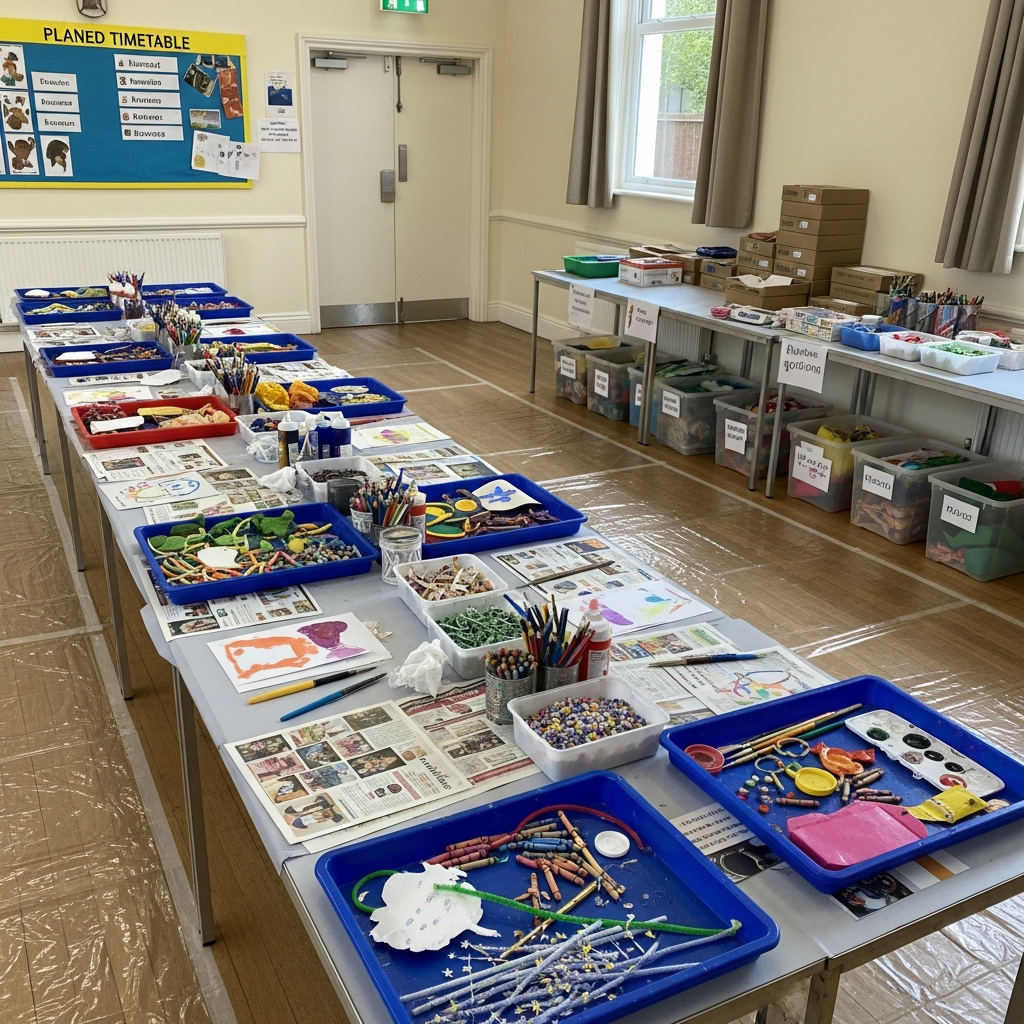
- Send a simple visual timetable of a typical session
- Provide photos of the room and materials
14.2 Social stories and visual supports
For children who benefit from structure, you might create a simple social story, for example:
- After school, I will go to the art club.
- I will hang up my coat and say hello.
- I will sit at a table and listen to the instructions.
- I can ask for help if I am not sure.
- If I feel worried, I can ask for a break.
- At the end, I will tidy up and wait for my grown-up.
Use photos or simple drawings to illustrate each step.
14.3 Agreeing a communication plan with the club
Before your child starts, agree:
- How staff will let you know how the session went (verbal handover, notebook, text)
- How you will share updates about your child (e.g. if they are tired, anxious, or had a difficult day at school)
- What to do if the club needs to contact you urgently
This helps everyone feel more secure.
15. Working with the Club Over Time
Once your child has started, ongoing communication and small adjustments can keep things on track.
15.1 First few sessions
- Ask for brief feedback after each session
- Notice how your child seems before and after the club (tired, energised, anxious, proud)
- Share any patterns you see with staff
If there are wobbles, problem-solve together rather than assuming it is not working.
15.2 Reviewing support and expectations
After a few weeks, you might ask for a short review conversation:
- What is going well?
- What is your child finding hard?
- Are there simple changes that could help (e.g. different seating, shorter instructions, extra movement breaks)?
A good club will welcome this and see it as part of inclusive practice.
15.3 When things are not working
If, despite adjustments, your child is consistently distressed or the club cannot meet their needs safely:
- It is not a failure on your part or your child’s
- Ask the club for honest feedback and any suggestions for alternative provision
- Speak to your local SENDIASS (SEND Information, Advice and Support Service) or parent–carer forum for ideas of more specialist options
Sometimes a different environment, smaller group, or one-to-one art sessions may be more appropriate.
16. Practical Checklists for Parents
Use these checklists to structure your thinking and conversations.
16.1 Quick phone/email checklist
- Do they welcome questions about SEND?
- Can they describe specific adaptations they make?
- Are staff DBS-checked and trained in safeguarding?
- Do they offer a trial or taster session?
- Are costs, including materials, clear and transparent?
16.2 Visit observation checklist
Environment
- Room is reasonably calm and not overcrowded
- Clear pathways and accessible layout
- Quiet space available if needed
- Materials stored safely
Structure and communication
- Visual timetable or clear written schedule
- Rules/expectations displayed simply
- Staff give clear, calm instructions
- Children know what to do and where to go
Staff behaviour
- Warm, respectful interactions
- Positive reinforcement used more than criticism
- Calm responses to challenging behaviour
- Staff appear attentive and engaged
16.3 SEND-specific checklist
- Club is willing to read a short summary of my child’s needs
- Reasonable adjustments discussed and agreed
- Plan for meltdowns or distress is clear
- Toileting/medical needs can be safely supported
- Communication plan with parents is agreed
17. Balancing Safety, Enjoyment and Realistic Expectations
Choosing an SEN-friendly art club is about finding a good enough fit, not perfection.
Consider:
- Safety and safeguarding as non-negotiable
- Inclusion and flexibility as essential for SEND
- Artistic quality as important, but secondary to your child’s wellbeing
It is also normal for:
- The first few sessions to be tiring or wobbly as your child adjusts
- Staff to need time to get to know your child and what works for them
- You to feel anxious and need reassurance
If the basics are strong and the club is willing to learn and adapt, it is often worth giving it a little time.
18. Summary and Next Steps
Finding an SEN-friendly after-school art club in the UK can feel like a big task, but breaking it down into clear steps makes it manageable:
- Clarify your child’s needs – sensory, social, communication and support.
- Research local options via school, Local Offer, parent forums and word of mouth.
- Contact clubs with specific questions about SEND, safeguarding and costs.
- Visit in person to observe environment, staff interactions and structure.
- Agree adjustments and a communication plan before your child starts.
- Review together after a few sessions and tweak support as needed.
A well-chosen art club can become a highlight of your child’s week: a place where they feel safe, valued and proud of what they create. It can support confidence, social skills and emotional wellbeing in ways that last far beyond the end of each session.
If you are unsure where to begin, start by:
- Asking your child’s school which art clubs they know to be inclusive
- Checking your local authority’s SEND Local Offer for arts-based short breaks
- Talking to other parents of children with SEND in your area about their experiences
With the right questions and a clear sense of your child’s needs, you can navigate past poor or unsuitable providers and find an art club that truly supports your child to thrive.