How to Choose a Safe, Ofsted-Registered Arts Club for Primary School Children in the UK

How to Choose a Safe, Ofsted-Registered Arts Club for Primary School Children in the UK
Choosing an arts club for your primary-aged child can feel surprisingly stressful. You want them to be creative, confident and happy – but you also need to know they are safe, properly supervised, and learning from people who actually know what they’re doing.
In the UK, the quality of after-school arts provision varies hugely. Some clubs are brilliantly run, with strong safeguarding, qualified staff and rich, inspiring activities. Others are little more than glorified babysitting, with poor supervision, no clear curriculum and worrying gaps in safety.
This guide walks you step-by-step through how to choose a safe, Ofsted-registered arts club for primary school children in the UK. It is written for parents who want practical, specific guidance, not vague reassurance.
We will cover:
- What Ofsted registration really means (and when it’s required)
- How to check safeguarding, DBS and policies
- What good-quality arts teaching looks like for 4–11 year olds
- Staff qualifications and ratios you should expect
- Typical UK costs, funding help and hidden fees
- SEND inclusion and accessibility questions
- Borough and local authority differences
- Red flags that should make you walk away
- Exact questions to ask on a club visit
- Practical checklists you can use immediately
1. Why Choose an Arts Club in Primary School?
1.1 Benefits beyond drawing and painting
A good arts club is about far more than just making something to bring home. For primary-aged children, arts activities can:
- Build confidence – especially for quieter children who may not shine in sport or whole-class activities.
- Develop fine motor skills – cutting, drawing, sculpting and crafting all support handwriting and coordination.
- Support emotional regulation – creative activities can help children express feelings they can’t yet put into words.
- Boost problem-solving and perseverance – planning a project, trying techniques, coping when things go wrong.
- Encourage social skills – sharing materials, giving and receiving feedback, working on group pieces.
These benefits are particularly valuable after school, when children are tired and may not respond well to more formal, academic-style clubs.
1.2 When an arts club is a good fit
An arts club can be especially helpful if:
- Your child is anxious or reluctant about school and needs a positive, low-pressure experience on site.
- You work later hours and need reliable wraparound care that is more than just screen time.
- Your child loves drawing, making or designing and school art lessons feel too limited.
- Your child struggles with team sports or noisy environments and needs a calmer, structured activity.
However, not all arts clubs are equal. The rest of this guide focuses on how to tell the difference between a safe, high-quality club and one you should avoid.
2. Understanding Ofsted Registration for Arts Clubs
2.1 When does an arts club need to be Ofsted-registered?
In England, Ofsted registration for after-school arts clubs depends mainly on age, hours and purpose.
An arts club usually must register with Ofsted if:
- It cares for children under 8 for more than 2 hours a day, and
- It is not run directly by a school as part of the normal school day, and
- Its main purpose is childcare (not just a short, specialist coaching session).
Many after-school arts clubs do meet these criteria, especially if they:
- Run straight after school until 5.30–6pm
- Provide snacks and general supervision as well as arts activities
- Accept children from Reception upwards
However, some shorter, specialist arts sessions (e.g. a 60–90 minute pottery workshop) may be exempt from registration, especially if:
- They run for less than 2 hours, and
- Parents are expected to stay on site, or
- They are clearly a specialist coaching/tuition session rather than wraparound childcare.
Key point: Ofsted registration is a strong safety and quality signal for wraparound arts clubs, but not all good arts providers are required to register. The important thing is to understand why they are or are not registered and what systems they have in place instead.
2.2 Types of Ofsted registration you might see
You may come across different Ofsted registers:
- Early Years Register (EYR) – for providers caring for children from birth to the 31 August after their 5th birthday.
- Compulsory Childcare Register (CCR) – for providers caring for children from the end of the EYFS (usually age 5) up to age 8.
- Voluntary Childcare Register (VCR) – for providers who are not required to register (e.g. caring only for over-8s) but choose to do so.
A wraparound arts club for primary children may be on:
- EYR + CCR (if they take Reception children and run as childcare), or
- CCR only (if they only take children over 5), or
- VCR (if they mainly serve over-8s but choose to register).
2.3 How to check Ofsted registration
You can:
- Ask the provider directly: “Are you Ofsted-registered? Which register are you on?”
- Request their URN (Unique Reference Number).
- Search the URN on the Ofsted website (Ofsted reports section) to see:
- Their registration status
- Latest inspection outcome
- Any actions or concerns raised
If a club claims to be Ofsted-registered but cannot provide a URN or it doesn’t show up on the Ofsted site, treat this as a serious red flag.
2.4 What Ofsted registration does (and doesn’t) guarantee
Ofsted registration means:
- Basic safeguarding and welfare requirements must be met.
- Staff must have enhanced DBS checks.
- There are rules on ratios, premises safety, first aid and record-keeping.
- The club is subject to inspection and can be held to account.
However, Ofsted registration does not guarantee:
- High-quality arts teaching or inspiring activities.
- That every staff member is an artist or qualified art educator.
- That your child will love it.
You still need to look carefully at quality, ethos and fit for your child, which we cover in later sections.
3. Safeguarding and Child Protection: Non-Negotiables
Safeguarding should be your starting point, not an afterthought. A club can be wonderfully creative, but if safeguarding is weak, it is not safe.
3.1 What strong safeguarding looks like in an arts club
A safe, well-run arts club should have:
- A written safeguarding/child protection policy, available to parents.
- A named Designated Safeguarding Lead (DSL) – someone trained to handle concerns.
- Safer recruitment processes (references, DBS, checks on gaps in employment).
- Clear procedures for reporting concerns about staff or other children.
- A code of conduct for staff, including appropriate boundaries.
- Whistleblowing procedures so staff can raise concerns safely.
Ask to see the safeguarding policy. It doesn’t need to be perfect legalese, but it should be clear, specific and up to date (reviewed within the last 1–2 years).
3.2 DBS checks and supervision
Every adult working directly with children should have an enhanced DBS check. For Ofsted-registered provision, this is mandatory.
Ask:
- “Do all staff and regular volunteers have enhanced DBS checks?”
- “How often are DBS checks renewed or updated?”
- “Are there ever times when a single adult is alone with a child?”
In a well-run club:
- Staff are never alone with a child in a closed room.
- Toileting is managed safely (younger children escorted appropriately, but with privacy respected).
- One-to-one support (e.g. for SEND) is visible and accountable.
3.3 Collection, drop-off and missing child procedures
For after-school arts clubs, safe handover is crucial.
Check that the club has:
- A clear register of who is attending each session.
- A written collection policy – who can collect, what ID is needed, what happens if someone unknown arrives.
- A password system or similar for new adults collecting.
- A late collection policy – including what happens if parents cannot be reached.
- A missing child policy – what they do if a child does not arrive from class or goes missing on site.
Ask specifically:
- “How do you ensure children arrive safely from their classroom to the club?” (especially if it’s on school premises)
- “What happens if my child is absent from school – how do you avoid them being expected at club?”
3.4 Online safety and photos of artwork
Some arts clubs like to share children’s work on social media or websites.
Ask:
- “Do you take photos of children’s artwork?”
- “How do you get consent?”
- “Are children’s names ever visible?”
A cautious, professional club will:
- Use opt-in consent for any photos.
- Avoid posting names alongside identifiable work.
- Respect your decision if you prefer no photos.
4. Health, Safety and the Arts Environment
Arts activities often involve tools, materials and mess. That’s part of the fun – but it must be managed safely.

4.1 Premises and environment
On a visit, look for:
- Secure entry – doors not left propped open; visitors signed in.
- Clear fire exits – not blocked by easels, tables or storage.
- Visible fire evacuation procedures.
- First aid kit easily accessible and in date.
- Clean, well-lit space – not cramped or dangerously cluttered.
- Safe storage of sharp tools, glues, solvents and cleaning products.
If the club uses a school classroom, check that:
- Hazardous materials (e.g. strong glues, chemicals) are locked away.
- Children are not left unsupervised with classroom resources they shouldn’t access.
4.2 Risk assessments
A serious provider will have written risk assessments for:
- The premises
- Regular activities (e.g. painting, clay, collage, printmaking)
- Any off-site trips or exhibitions
You don’t need to read every line, but you can ask:
- “Do you have risk assessments for your activities?”
- “How do you adapt them for younger children or those with additional needs?”
4.3 Materials and allergies
Check:
- Are paints and glues non-toxic and age-appropriate?
- How do they manage allergies (e.g. latex, certain clays, food-based materials)?
- Do they use food items (e.g. pasta, lentils) in art, and how do they manage this for children with allergies or cultural/religious restrictions?
If your child has eczema, asthma or skin sensitivities, ask about:
- Types of paint (e.g. acrylic vs watercolour)
- Use of powdered materials (e.g. chalk pastels, clay dust)
- Handwashing facilities and moisturiser policies (you may need to provide your own).
4.4 Snacks, food hygiene and mealtimes
If the arts club doubles as wraparound care, it may provide snacks or a light tea.
Ask:
- “Do you provide food? If so, what kind?”
- “How do you manage allergies and dietary requirements?”
- “Are staff trained in basic food hygiene?”
Look for:
- Allergy information clearly recorded and visible to staff.
- Separate utensils and surfaces for food preparation.
- No sharing of water bottles or open food between children.
5. Staff Qualifications, Ratios and Experience
5.1 What qualifications should staff have?
There is no single required “arts club qualification”, but for Ofsted-registered provision you should expect:
- At least one staff member with a relevant childcare qualification (e.g. Level 2 or 3 in Playwork, Childcare, Supporting Teaching and Learning).
- A named manager with experience in leading childcare or educational settings.
- At least one paediatric first aider on site at all times.
For the arts side, look for:
- Staff with art, design, drama or craft backgrounds (e.g. art degrees, art teaching experience, practising artists).
- Evidence of planning and progression in activities (not just “free drawing” every week).
Ask directly:
- “What qualifications do your staff hold – both in childcare and in the arts?”
- “Who plans the activities, and what is their background?”
5.2 Staff-to-child ratios
Ofsted guidance for out-of-school care is less prescriptive than for nurseries, but good practice for primary-aged children is typically:
- Around 1:8 for 4–5 year olds
- Around 1:10–1:12 for older primary children
For arts activities involving tools, scissors, glue guns or messy materials, lower ratios are safer and more effective.
Ask:
- “What is your usual ratio of staff to children?”
- “Do you reduce ratios for more complex activities?”
5.3 Training and ongoing development
Beyond initial qualifications, ask about:
- Safeguarding training – how often is it refreshed?
- First aid training – who is trained and when was it last updated?
- Behaviour management – do staff receive training in positive behaviour support?
- SEND awareness – any training in autism, ADHD, sensory needs, etc.?
A strong provider will be able to describe recent training and how it has influenced their practice.
5.4 Stability and turnover of staff
High staff turnover can affect consistency, relationships and safety.
Ask:
- “How long have your core staff been with the club?”
- “Do you use agency staff? If so, how do you ensure continuity and safeguarding?”
Look for:
- A stable core team who know the children well.
- Clear induction processes for any new or temporary staff.
6. What High-Quality Arts Provision Looks Like for 4–11 Year Olds
6.1 Variety and progression
A high-quality arts club should offer more than colouring sheets and free drawing.
Look for:
- A range of media: drawing, painting, collage, printmaking, 3D work, textiles, possibly digital art.
- Progression over time: skills revisited and built upon, not random disconnected activities.
- Opportunities for both guided projects and child-led exploration.
Ask to see:
- A termly plan or overview of themes and techniques.
- Examples of work from different age groups.
6.2 Age-appropriate expectations
For younger children (Reception–Year 2), expect:
- Focus on exploration and sensory experience.
- Simple techniques (printing, collage, basic colour mixing).
- Shorter activities with clear, visual instructions.
For older children (Years 3–6), expect:
- More sustained projects over several weeks.
- Introduction to artists, designers or cultural references.
- Opportunities to plan, review and refine their work.
6.3 Encouraging creativity, not perfectionism
Watch how staff talk about children’s work. In a healthy arts environment, you should hear:
- “Tell me about your picture” rather than “What is it meant to be?”
- “I like how you tried that new technique” rather than “Stay inside the lines”.
Avoid clubs where:
- Every child’s work looks identical (suggesting over-directed, template-based tasks).
- Staff correct children’s work heavily or do it for them.
6.4 Links to confidence and social skills
A good arts club will deliberately use activities to build:
- Turn-taking and sharing (e.g. shared resources, group murals).
- Communication skills (talking about ideas, giving feedback kindly).
- Resilience (coping when a project doesn’t go to plan).
Ask:
- “How do you support children who are anxious about getting things ‘wrong’?”
- “Do children ever work on group projects? How do you manage that?”
7. Behaviour, Routines and Emotional Climate
7.1 Behaviour expectations and boundaries
Ask to see the club’s behaviour policy. It should:
- Use positive language (what children should do, not just what they shouldn’t).
- Explain how staff respond to low-level disruption.
- Outline steps for more serious incidents.
On a visit, observe:
- Are children generally calm and engaged?
- Do staff speak to children respectfully and consistently?
- Are rules clear and fairly applied?
7.2 Supporting tired or overwhelmed children
After school, many children are:
- Hungry
- Tired
- Emotionally overloaded
Ask:
- “What happens if a child is too tired to join in?”
- “Is there a quiet space for children who need a break?”
A thoughtful club will:
- Offer a snack and drink early in the session.
- Provide a calm corner or quiet table.
- Allow children some choice about when to join activities.
7.3 Bullying and peer difficulties
Ask:
- “How do you handle unkind behaviour or bullying?”
- “How do you support children who struggle to make friends?”
Look for:
- Clear, zero-tolerance stance on bullying.
- Practical strategies (e.g. buddy systems, small group work, staff modelling inclusive language).
8. SEND Inclusion and Accessibility
8.1 Legal duties and ethos
Under the Equality Act 2010, clubs must make reasonable adjustments so children with SEND are not disadvantaged.
Ask:
- “Do you welcome children with SEND?”
- “Can you give examples of adjustments you’ve made in the past?”
You’re looking for a genuine, thoughtful response, not just “Yes, we’re inclusive” with no detail.
8.2 Practical adjustments in an arts setting
Examples of reasonable adjustments might include:
- Visual timetables and clear routines.
- Noise-reducing strategies (e.g. smaller groups, quiet corners, headphones if appropriate).
- Alternative tools (e.g. chunkier brushes, adaptive scissors, pencil grips).
- Sensory-friendly materials for children who dislike certain textures.
- Extra adult support during transitions or more complex activities.
If your child has an EHCP or support plan at school, ask:
- “Can we share my child’s school support plan with you?”
- “How would you work with the school SENCO if needed?”
8.3 One-to-one support and funding
Some children may need 1:1 support to attend safely.
Ask:
- “Can you accommodate children who need 1:1 support?”
- “Do you expect parents to fund additional support, or can you access local funding?”
Provision varies by local authority. Some boroughs have short breaks or inclusion funding that can support access to clubs; others expect parents to pay extra.
8.4 Physical accessibility
If your child has a physical disability or mobility needs, check:
- Step-free access to the room.
- Accessible toilets.
- Table heights and space to manoeuvre.
Ask:
- “Have you previously supported children with physical disabilities? What adjustments did you make?”
9. Costs, Funding and Hidden Fees
9.1 Typical UK cost ranges
Costs vary by region, venue and whether the club is mainly childcare or specialist tuition.
As a rough guide (2024–25):
- School-based arts after-school club (1–1.5 hours): £5–£12 per session.
- Wraparound arts club (e.g. 3–6pm, including snack): £10–£20 per session, often £50–£100 per week.
- Specialist arts studio club (off-site, 1.5–2 hours): £12–£25 per session, depending on materials and location.
London and the South East tend to be at the higher end; some northern and rural areas may be lower.
9.2 Hidden or extra costs to watch for
Ask clearly about:
- Registration or membership fees – one-off or annual.
- Materials fees – are all materials included, or are there surcharges for special projects?
- Exhibition or performance fees – charges for end-of-term shows, framing, or portfolios.
- Late collection fees – how much, and from what time?
- Holiday club pricing – often different from term-time.
Request a written breakdown of costs before committing.
9.3 Using childcare support schemes
If the arts club is Ofsted-registered and counts as childcare, you may be able to use:
- Tax-Free Childcare (20% top-up on eligible costs).
- Universal Credit childcare element (if eligible).
- Childcare vouchers (for parents still in legacy schemes).
Ask the provider:
- “Do you accept Tax-Free Childcare / childcare vouchers?”
- “What is your Ofsted URN for my claim?”
Note: Short, specialist arts sessions that are not registered as childcare may not be eligible for these schemes.
9.4 Cancellation, refunds and notice periods
Life happens – children change schools, activities clash, or your circumstances shift.
Ask:
- “What is your notice period if we need to stop?”
- “Do you offer refunds for missed sessions due to illness or school trips?”
- “What happens if the club has to cancel a session?”
Look for clear, written terms that feel fair and transparent.
10. Borough and Local Authority Differences
10.1 Variation in provision and oversight
Across England, Scotland, Wales and Northern Ireland, there are differences in:
- Regulatory bodies (Ofsted in England; Care Inspectorate Wales; Care Inspectorate in Scotland; ETI/RQIA in Northern Ireland).
- Local authority support for wraparound care and arts programmes.
- Availability of funding for SEND inclusion or low-income families.
Even within England, different London boroughs and local authorities vary in:
- How actively they promote and monitor after-school provision.
- The strength of school–provider partnerships.
10.2 Using local authority and Family Information Services
Most councils have a Family Information Service (FIS) or similar, which can:
- Provide lists of registered childcare providers, including arts clubs.
- Advise on funding, tax credits and local grants.
- Sometimes signpost to SEND-friendly or specialist arts provision.
Search “[your borough] Family Information Service after school clubs” and check their listings.
10.3 School-based vs community-based clubs
In some boroughs, most arts clubs are:
- School-based (run by the school or an external provider on site).
- Community-based (in church halls, community centres, arts studios).
School-based clubs often have:
- Easier handover from class to club.
- Stronger links with school safeguarding systems.
Community-based clubs may offer:
- More specialist facilities (e.g. kilns, print presses, dedicated studios).
- Mixed-age groups from different schools, which can be great for social confidence.
Both can be excellent – the key is to check safety, quality and fit carefully.
11. Visiting a Club: What to Look For and What to Ask
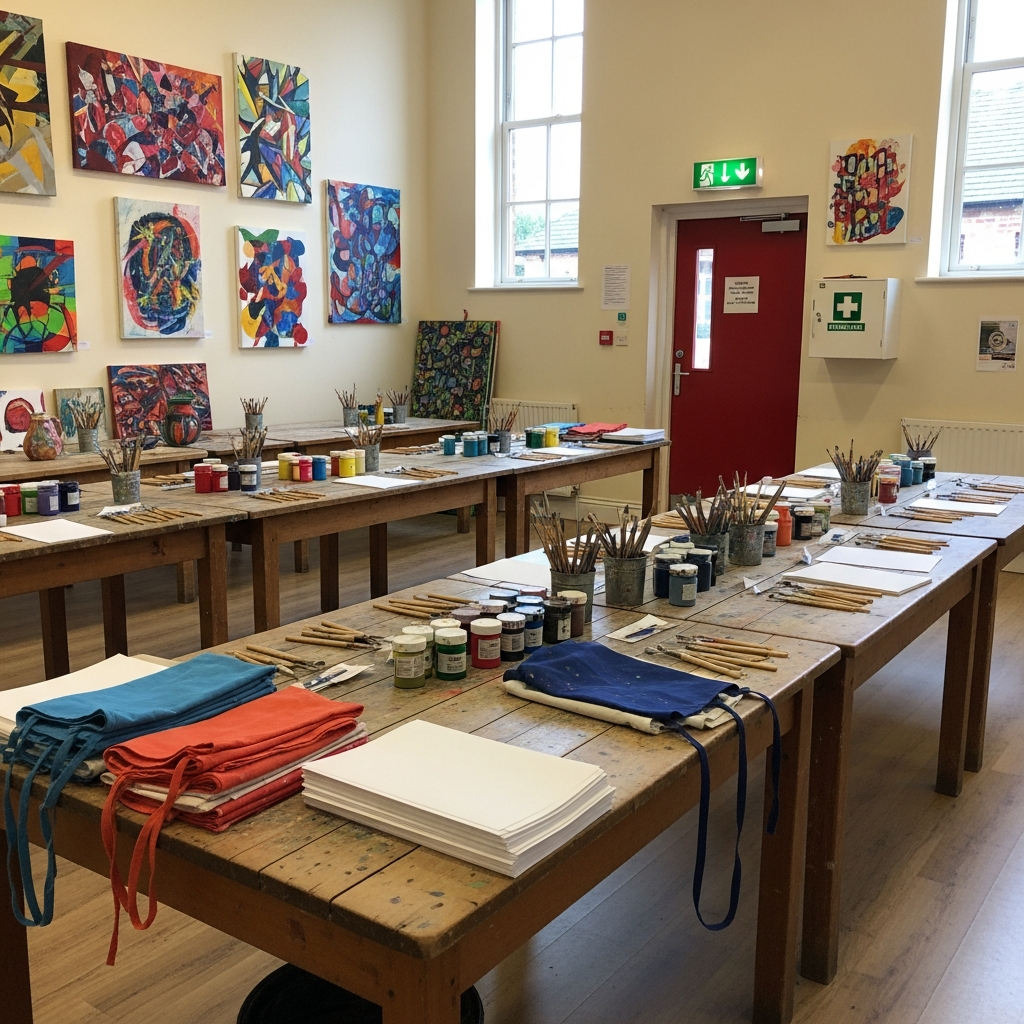
A visit (or at least observing a session in progress) is one of the most powerful ways to judge a club.
11.1 Before you visit
Prepare a short list of priorities:
- Safety and safeguarding
- Staff warmth and professionalism
- Quality of arts activities
- Fit for your child’s temperament and needs
Bring:
- A notebook or notes app
- Any key information about your child (allergies, SEND, anxieties)
11.2 What to observe during the visit
As you look around, notice:
- Atmosphere – calm, purposeful, chaotic, tense?
- Staff interactions – warm, patient, rushed, dismissive?
- Children’s engagement – absorbed, restless, bored, distressed?
- Use of space – safe, organised, or cluttered and hazardous?
- Display of work – varied, child-led, or all identical and adult-directed?
Trust your instincts, but back them up with specific observations.
11.3 Key questions to ask
Here is a practical list of questions you can adapt:
About safety and safeguarding
- “Are you Ofsted-registered? What is your URN?”
- “Can I see your safeguarding and behaviour policies?”
- “Do all staff have enhanced DBS checks?”
- “Who is your Designated Safeguarding Lead?”
- “How do you manage collection and handover at the end of the session?”
About staff and training
- “What qualifications and experience do your staff have?”
- “What training have staff had in safeguarding and first aid?”
- “What is your usual staff-to-child ratio?”
About activities and curriculum
- “Can I see a sample plan for a half-term of sessions?”
- “How do you adapt activities for different ages and abilities?”
- “Do children get any choice in what they work on?”
About behaviour and emotional support
- “How do you support children who are anxious or reluctant to join in?”
- “How do you handle behaviour that disrupts others?”
About SEND and inclusion
- “Do you currently have children with SEND attending?”
- “What adjustments could you make for a child with [briefly describe your child’s needs]?”
About costs and admin
- “What is the full cost per session, including any materials or registration fees?”
- “What is your notice period if we need to stop?”
- “Do you accept Tax-Free Childcare or childcare vouchers?”
11.4 Involving your child in the decision
If possible, let your child:
- Visit the space with you.
- See examples of artwork.
- Meet at least one staff member.
Afterwards, ask specific questions:
- “How did you feel in that room?”
- “Did anything worry you?”
- “Is there anything you’d really like to try there?”
You are the adult making the final decision, but your child’s sense of safety and comfort matters.
12. Red Flags: When to Think Twice or Walk Away
12.1 Safeguarding and safety red flags
Be very cautious if:
- The club cannot show a safeguarding policy.
- Staff seem defensive or vague when asked about DBS checks.
- There is no clear system for collection and handover.
- Doors are left unsecured and visitors can walk in freely.
- Hazardous materials or tools are within easy reach of unsupervised children.
12.2 Quality and ethos red flags
Watch out for:
- Children looking bored, distressed or frequently ignored.
- Staff shouting, humiliating or mocking children’s work.
- Activities that are repetitive and low-challenge (e.g. colouring sheets every week).
- No evidence of planning – staff appear to improvise every session.
12.3 Communication and professionalism red flags
Be wary if:
- Emails and calls go unanswered or responses are very slow.
- Policies, fees and terms are not provided in writing.
- The provider is reluctant to let you visit or observe a session.
- They dismiss your questions about SEND, allergies or anxieties.
12.4 Gut feeling
If something feels off, even if you can’t immediately explain why, pause.
You can:
- Ask follow-up questions.
- Speak to other parents.
- Check Ofsted reports or online reviews.
- Consider alternative providers.
Your child’s safety and wellbeing are more important than convenience.
13. Supporting Confidence, Resilience and Social Skills Through Arts Clubs
13.1 How arts clubs build confidence
A well-run arts club can be transformative for a child’s confidence because:
- There is often no single ‘right answer’, reducing fear of failure.
- Children can see tangible progress in their skills over time.
- They receive specific praise for effort, creativity and persistence.
Ask the provider:
- “How do you encourage children who are very self-critical?”
- “How do you celebrate children’s achievements?”
13.2 Social skills and friendships
Arts clubs can support social development by:
- Offering low-pressure conversation starters (talking about each other’s work).
- Providing shared goals (group murals, collaborative projects).
- Allowing children to work alongside others without constant direct interaction – helpful for shy or autistic children.
You can ask:
- “Do you deliberately mix children into different groups, or let them choose?”
- “How do you support children who are new or don’t know anyone?”
13.3 Helping your child get the most from the club
At home, you can:
- Show interest: “Tell me about what you made today.”
- Focus on process, not product: “What did you enjoy most?” rather than “What is it?”
- Normalise mistakes: share times when your own creative projects went wrong.
- Avoid pressuring them to perform or produce for you every week.
If your child is anxious about starting, you might:
- Arrange a shorter first session or early pick-up.
- Ask if they can attend with a friend initially.
- Visit the room together before their first full session.
14. Practical Checklists for Parents
14.1 Quick safety and quality checklist
Use this as a simple yes/no tool when evaluating a club:
Safety and safeguarding
- Ofsted-registered (where applicable) and URN provided
- Written safeguarding policy available
- Designated Safeguarding Lead named
- All staff have enhanced DBS checks
- Clear collection and handover procedures
- Secure entry and visitor sign-in
Health and safety
- Fire exits clear and evacuation plan visible
- First aid kit accessible and in date
- At least one paediatric first aider on site
- Hazardous materials stored safely
- Risk assessments in place for activities
Staff and training
- Staff qualifications explained clearly
- Reasonable staff-to-child ratios
- Evidence of safeguarding and first aid training
- Low staff turnover or clear induction for new staff
Arts quality and ethos
- Variety of media and techniques offered
- Evidence of planning and progression
- Children’s work shows individuality
- Staff encourage creativity, not perfectionism
Inclusion and SEND
- Welcoming attitude to SEND
- Willingness to discuss reasonable adjustments
- Physical accessibility considered (if relevant)
Admin and costs
- Clear written fees and terms
- Explanation of any extra or hidden costs
- Reasonable notice period and cancellation policy
14.2 Questions to ask yourself after a visit
After visiting, reflect on:
- Did I feel comfortable leaving my child there?
- Did staff seem genuinely interested in my child as an individual?
- Would my child feel safe and welcomed in that environment?
- Does the cost feel fair for the quality and length of the session?
- How does this club compare to other options (including non-arts clubs)?
15. Special Considerations for Different Types of Arts Clubs
15.1 Visual arts vs performing arts
This guide focuses mainly on visual arts (drawing, painting, crafts), but many principles also apply to performing arts (drama, dance, music).
For performing arts clubs, pay extra attention to:
- Changing areas (privacy and safeguarding).
- Use of stages and equipment (falls, lighting, sound levels).
- Rehearsal schedules and expectations around performances.
15.2 Faith-based or culturally specific arts clubs
Some clubs are run by faith organisations or focus on particular cultural traditions.
Check:
- Whether the arts content aligns with your family’s values.
- How inclusive they are of children from different backgrounds.
- Whether any religious activities are part of the session and if they are optional.
15.3 Online or hybrid arts clubs
A few providers offer online arts sessions for children at home.
If you consider these, think about:
- Supervision at home – you will still need to be nearby.
- Materials – what you need to provide and any safety issues.
- Screen time – balancing creative benefits with overall screen use.
Online clubs are not a substitute for regulated childcare, but can be a useful supplement.
16. Working with the School and Other Parents
16.1 Talking to your child’s teacher
If the arts club is school-based, it can help to:
- Let the class teacher know your child is attending.
- Share any concerns (e.g. tiredness, anxiety, sensory needs) that might affect after-school participation.
Teachers can sometimes:
- Help with transitions from class to club.
- Flag if your child seems overwhelmed by long days.
16.2 Speaking to other parents
Word of mouth is powerful, but try to get specifics, not just “It’s great” or “We didn’t like it”. Ask:
- “What does your child actually do there?”
- “How do the staff handle behaviour or worries?”
- “Have there been any issues with safety or communication?”
Remember that different children have different needs; what suits one family may not suit another.
16.3 Reviewing and feeding back
Once your child is attending:
- Keep an eye on their mood before and after sessions.
- Notice any changes in sleep, behaviour or anxiety.
- Share constructive feedback with the provider – good clubs welcome this.
If concerns arise, raise them early and calmly, giving the club a chance to respond.
17. Step-by-Step: From Shortlist to Confident Choice
To pull everything together, here is a simple process you can follow:
-
Clarify your priorities
- Is your main goal childcare, creative development, confidence-building, or a mix?
- What are your non-negotiables (e.g. Ofsted registration, SEND support, cost limit)?
-
Create a shortlist
- Use school newsletters, local Facebook groups, Family Information Services and online searches.
- Aim for 2–4 options if possible.
-
Check registration and basic info
- Confirm Ofsted (or equivalent) status where relevant.
- Note costs, times, ages, and location.
-
Arrange visits or trial sessions
- Visit in person if you can.
- Observe a session or at least see the space in use.
-
Use the checklists and questions
- Ask about safeguarding, staff, activities, SEND, costs.
- Take notes so you can compare later.
-
Discuss with your child
- Share what you saw in age-appropriate language.
- Listen to any worries or excitement.
-
Make a provisional choice
- Start with a half-term block if possible, rather than a full year.
-
Review after a few weeks
- Check in with your child and your own observations.
- Decide whether to continue, raise concerns, or try a different option.
18. Summary and Next Steps
Choosing an arts club for your primary-aged child in the UK is about balancing safety, quality and fit.
A safe, Ofsted-registered arts club (where registration is required) should offer:
- Robust safeguarding and health and safety systems.
- Qualified, caring staff with appropriate ratios.
- Thoughtfully planned arts activities that build skills, confidence and joy.
- A genuinely inclusive approach to SEND and diverse needs.
- Clear, transparent costs and policies.
Your role as a parent is to:
- Ask direct, specific questions.
- Observe how staff interact with children.
- Trust your instincts, backed by evidence.
- Keep your child’s individual temperament and needs at the centre of your decision.
You do not need to be an arts expert or an education professional to make a good choice. With the checklists and questions in this guide, you can approach providers with confidence and clarity.
If you’re ready to start comparing options, your next steps could be:
- Make a shortlist of local arts clubs (school-based and community-based).
- Check Ofsted (or equivalent) registration where applicable.
- Arrange at least one visit or trial session.
- Use the checklists in Section 14 to structure your decision.
A well-chosen arts club can become a highlight of your child’s week – a place where they feel safe, valued and excited to create. With careful evaluation, you can find a setting that supports not only their artistic skills, but also their confidence, friendships and long-term love of learning.